
Source review · September 25, 2026

A clear argument needs an open record.

We support the HAIL Act. The source library distinguishes technical documentation, court rulings, owner accounts, estimates and our policy position.

Product documentation

How the tools work

Google documents automatically collected events, acquisition reporting and enhanced measurement. These support the three-question example. Appointment reporting requires an appropriate event or integration; a standard analytics tag does not inherently know every completed booking.

The business may see a summary while its provider receives more detailed records. The demonstration uses synthetic data and is not a capture of a real Analytics request.

Living vendor documentation reviewed September 25, 2026. Current behavior should not be projected backward into cases involving older configurations.
Different capabilities

Settings and recipients matter

Advertising integrations, user-provided data, session replay, consent settings, chat and sensitive forms introduce distinct questions. A pseudonymous or hashed identifier is not proof of anonymity.

Google’s consent-mode documentation distinguishes basic blocking from advanced measurements without cookies. Microsoft describes session recordings and masking. Neither description establishes what a particular defendant’s website did.

Court docket · A specific filing restriction

A court restricted one plaintiff’s filings.

In Shah v. Crain Communications, a July 20, 2026 order declared Vivek Shah a vexatious litigant and imposed prefiling review on new CIPA or related digital-privacy cases he files in the Central District of California. The public docket records the order.

Shah appealed. The appellate docket records a September 16 denial of his request to pause the order. That procedural ruling does not decide the appeal’s merits.

We reviewed the publicly reproduced docket entries; the complete underlying order was not retrieved. The restriction concerns this litigant and these filings in one district. It does not establish that all website-privacy cases lack merit.

California statute · Civil remedy

Why actual damages and a legal violation are different questions.

Penal Code §637.2 allows $5,000 per violation or three times actual damages, whichever is greater, and does not require proof of actual damages. A qualifying violation still has to be established.

That distinction helps explain potential exposure. It does not mean that every person without provable monetary loss experienced no privacy harm.

Court order · Pleading stage

Jones v. Skullcandy

In a March 12, 2026 order, the Southern District of California denied a motion to dismiss claims concerning a retail website. The pleaded facts included Google Analytics alongside Meta Pixel, Meta CAPI, DoubleClick, identifiers, purchases and advertising uses.

What it shows: claims involving familiar website technologies were allowed to proceed. What it does not show: final liability, an analytics-only configuration or a small local business. The described technology facts are allegations evaluated at the pleading stage.

No. 3:25-cv-01759, Document 13. Later disposition was not independently established in this review.

Appellate opinion · Class certification

Doe v. Adventist

The California Court of Appeal considered Google Analytics on a patient portal and GA/Meta technologies associated with health-risk forms. It reversed class-certification denial for the health-risk-assessment subclass and in part for the portal subclass.

This was a class-certification decision, not a final liability judgment. It illustrates why public service pages and sensitive healthcare contexts should not be treated as equivalent.

No. B344951. Filed July 24, 2026; certified for publication August 24, 2026.

Independent reporting

Folsom Lake Heating & Air

CapRadio reported a website-related CIPA suit involving Tami Goldsmith and her husband’s HVAC business. Its account names a booking service referenced in the suit and attributes a settlement account to Goldsmith.

Limit: no underlying complaint, sufficiently matched docket, technical capture or settlement agreement was retrieved. This is not evidence that default GA4 alone caused liability. No settlement amount or campaign endorsement is asserted.

Published June 18, 2026. The fictional Maya story is not a reconstruction of Goldsmith’s experience.

Owner-reported spending

Second Star Technologies

Brandon Phipps told KERO/23ABC that his Bakersfield family business paid more than $20,000 in combined legal fees and settlement costs.

Limit: invoices and settlement terms have not been independently reviewed. The two components are not separately established. The reporting does not substantiate specific layoffs, lost sales or reduced services.

Published May 6, 2026; updated May 7.

Related official court record

Los Angeles Superior Court case 24STCV17428 names Second Star Technologies, LLC. Its index lists a November 4, 2024 settlement notice and December 19 dismissal request. Document contents were not retrieved; the record does not establish the payment amount, tracking setup or an explicit connection to KERO’s reported total. Official docket.

Owner-reported expectations

Elk Grove Plumbing

Belinda Gutierrez described an expected $20,000 cost to contest a claim and a proposed $15,000 settlement. These are alternative paths, not two amounts to add.

Limit: neither figure is independently verified as paid. Reporting at different dates describes differing demand amounts; this site does not use a demand figure.

Elk Grove Citizen, June 9, 2026, describing a May interview.

Attributed snapshot

Thousands of lawsuits

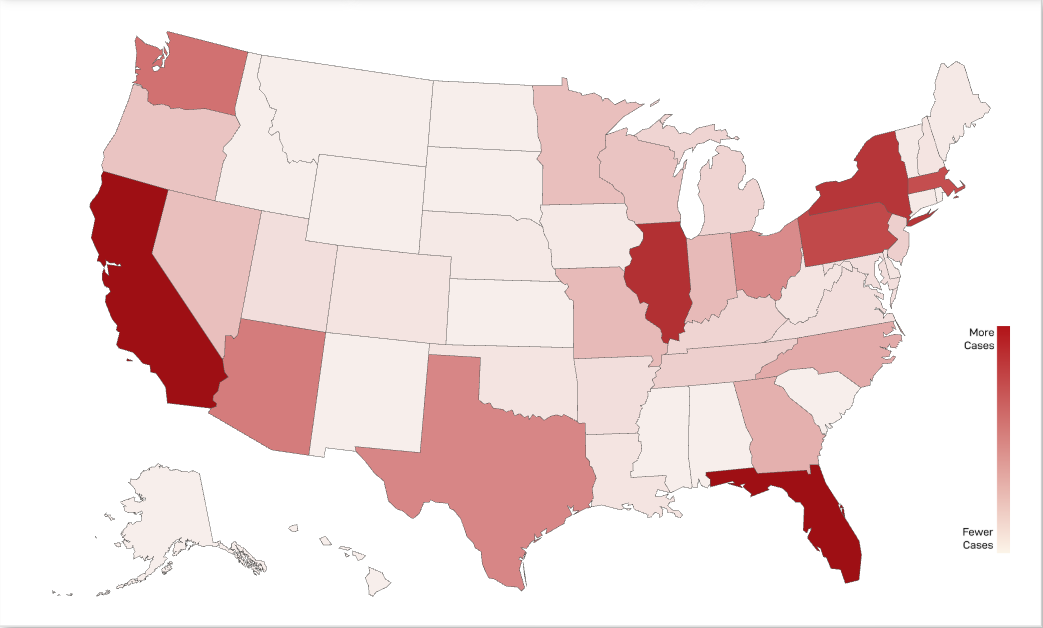
The Fisher Phillips tracker displayed 5,775 total cases when reviewed September 25, 2026, with all filters selected and a displayed date range of February 5, 2022–September 16, 2026.

Its stated universe is nationwide privacy litigation involving tracking in websites, apps or marketing emails. This is not a count only of CIPA lawsuits, small businesses, active cases, unique defendants or proven violations.

Limit: displayed components have reconciliation discrepancies. The landing-page methodology and report date range also differ. The snapshot is attributed to the tracker; it is not an independently reconciled dataset.

The research assistant’s database has different coverage. Its count should not be substituted for this figure or presented as a common sitewide total.

Fisher Phillips U.S. case heat map, with darker red shading for more tracked casesExplore the interactive map at Fisher Phillips
Static preview of the Fisher Phillips tracker, captured September 25, 2026. Displayed filing range: February 5, 2022–September 16, 2026; state and industry filters: All. Visit the source for its latest data and controls.

Introduced federal bill

H.R. 10263

The introduced HAIL Act text would bar covered surveillance-law claims and enforcement for commercial-purpose collection, processing or disclosure, including covered proceedings already underway.

Its reach is broader than small businesses, cases without harm or claims found frivolous. Our support for the proposal is a policy position, distinct from any owner, journalist or court’s endorsement.

See the bill page for the dated official status and full scope summary.

California law and legislation

CIPA and SB 690

CIPA originated in 1967. Its pen-register provisions were added in 2015, effective in 2016, and later amended. The entire present statute is not unchanged since the 1960s.

Section 637.2 permits statutory relief without proof of actual damages. That does not establish that a plaintiff experienced no privacy injury.

SB 690 and HAIL have different coverage. Our comparison separates the California measure from the federal proposal and identifies the status record used.

Attributed estimates

Testimony is not a payment ledger

Fisher Phillips reported attorney Usama Kahf’s July 1, 2026 testimony estimating typical settlements at $15,000–$25,000 and aggregate costs above $500 million.

Limit: the reviewed testimony does not supply an auditable payment dataset. A demand multiplier, resolution rates, duplicates and fee allocation remain unresolved. We do not adopt the aggregate as verified business losses.

Commissioned model

Oxford Economics

The June 2026 report commissioned by Reform CIPA models defense and private-demand costs using counts, litigation-stage assumptions and anonymous expert inputs. It labels the defense model illustrative and partly unrealized.

Limit: no payment-level demand dataset or interview sample size is disclosed. The coalition release and linked report differ in their case and defense-cost totals. These remain attributed estimates.

Settlement agreement

Look beyond the payment

The Oracle settlement includes nonmonetary commitments about data collection and review practices in §3.5. Oracle denied wrongdoing.

This is not a small-business cost comparison. It shows why a blanket claim that settlements never produce privacy benefits is too broad. Unavailable terms are unknown, not proof that nothing changed.

Publication method

Keep the categories clear

We distinguish allegations from findings, pending proceedings from judgments, estimates from payments, and cases from businesses. No independently verified national small-business loss total is claimed.

The older cost calculator uses hypothetical cost divided by contribution margin. It is an illustration, not evidence of lost sales or a damages calculation.

New owner records need publishable documentation and separate labels for reported amounts, established obligations and verified payments. The contact page sends messages to a private project inbox; sending a note does not authorize its publication.

Later owner reporting

Elk Grove: September update

The Elk Grove Citizen reported on September 23 that Belinda Gutierrez intends to defend her business. The earlier $20,000 defense estimate and $15,000 settlement option are not paid costs or a final outcome.

Site update

September 25, 2026

Updated the public website with full-motion films and mobile editions, downloadable briefing materials, a public positions directory and a private contact inbox. Expanded owner accounts, including later reporting, and made the bill summary easier to find. Official bill records were checked September 25, 2026.

Earlier creative treatments are retained separately for project review. They are not part of the public reading path.

Corrections

A record that can improve.

Found an error or a missing source? Send a correction and source to the project’s private inbox. We review submissions before using them; submission does not make a claim verified or authorize public attribution.

No personal identity or organizational endorsement is implied by this project’s name.